

How The Thought Industry Is Failing You
The necessity of a shared perceptual reality

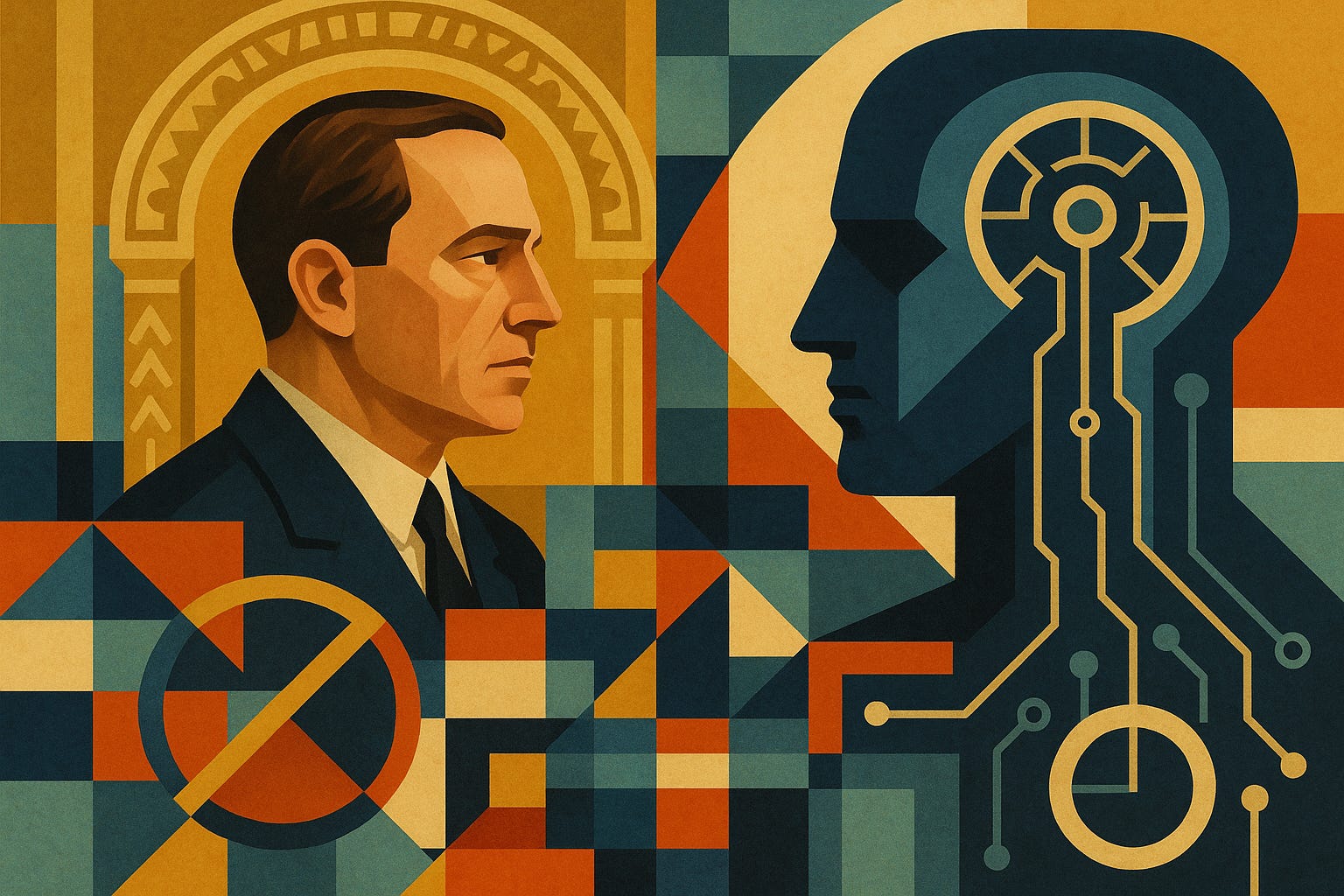
In addition to being American, Pope Leo XIV has taken a stance for himself and the church against the wave of technocratic corporate oligarchy that’s sweeping the globe. He’s highlighted AI as the biggest challenge facing humanity at the moment, and even his choice of name emphasizes this - the previous Leo was a staunch advocate for human rights during the Industrial Revolution. Ted Gioia has a fantastic dive into the Pope’s policies around this (highly recommend his writing!).
This is doubly interesting because no one is in a better position than a priest to identify what AI (and the tech world as a whole) is doing, because AI and priests are in the same business.
The main business of a priest is to sell faith: faith in a particular conception of divinity, faith in a particular understanding of humanity and this world, and faith in a particular method of interaction between them. This is actually where the title Pontifex (Latin for bridge-builder) comes from: Roman priests were the “bridges" between man and god.
A priest provides answers to existential questions like, "Why does this world exist?", "Who am I?", "Who is God?", etc. In its current iteration, AI answers your "smaller" questions, much like a search engine would. It's the natural evolution of a search engine and is already used as such, scanning everything online and summarizing results rather than simply giving them to you.
The business of sharing information with others is done by different job titles: academics, influencers, journalists, etc. The Information Technology industry (social media companies, search engines, AI, etc.) is the most powerful and visible group within the Thought Industry, and consequently is the highest valued economic sector at this time. These people share information and shape the worldview of others. Together, they make up the Thought Industry, where the output of their labor is not a physical product, but a shift in people's perceptual filters.
The Thought Industry functions like any other industry. Some people create products that provide value to consumers, others look to profit by rent-seeking, grifting, and/or repackaging other people's creations. It has externalities like any other industry, but differs from other industries in that it makes products for the mind instead of the body.
A great example of the value of the Thought Industry is the Copernican Revolution, or the observation that the planets revolve around the Sun rather than the Earth. Nothing about the physical world changed when we switched our perception from geocentric to heliocentric - the stars did not alter their motions, nor did any planets change their orbits - but that shift in perception unlocked new developments in seafaring, astronomy, physics, and culture that formed the philosophical, technological, cultural, and economic basis of our current society.
At its best, the Thought Industry does a few things very well: it educates people about the world we live in, makes a distinction between right and wrong, and constructively calls out people who don’t do the right thing. At its worst, it does the opposite: it green-lights tyranny, obscures the truth, and divides people based on relatively minor differences. When the Thought Industry does its job, it creates a healthy, high-trust environment with a shared perceptual reality.
The cultural climate we find ourselves in today does not facilitate this. The Thought Industry has moved from products that are one-size-fits-all to those that are tailor-made. The algorithm divides and conquers us, shows us what we already believe to be the truth, and enables the propaganda of the status quo. We don't agree on anything because the Thought Industry has bought and sold our perceptual realities as commodities on the global market.
The great sorting into individual perceptual bubbles has fragmented us, and this is why things are so culturally, politically, and societally tense - it’s as if we've started attending different churches. Incredibly bloody conflicts usually follow religious schisms, such as the wars following the Protestant Reformation or the Islamic civil wars between Sunni/Shia followers of Muhammad.
Let me be clear: I am not advocating for conformity in religion, politics, or thought. Plurality of belief is a virtue, but only when the thought leaders emphasize what unites everyone rather than divides them. Otherwise, baser instincts of tribalism take over and result in a fragmentation of society.
The fallout from this shift is visible before our eyes: in the past few months, we’ve seen an increase in all sorts of political violence. Assassinations of politicians and activists, protestors collapsing governments, all while the rhetoric online gets hotter with every incident. This is where the Thought Industry, and the thought leaders that accompany them of late, have failed.
The solution to diffusing the tension is to focus on what unites everyone rather than divides everyone. Journalists ideally speak to the shared concerns of everyone, academics/teachers ideally educate everyone on the issues that face everyone, and spiritual leaders ideally speak to the level of the souls that exist in everyone. This was the big promise of social media in its early days - Facebook’s mission has always involved some promise of connecting the world.
This is why the best placed people to combat the failings of the Thought Industry are those who are in the Thought Industry - they’re the ones able to recognize when our shared perceptual reality has fallen apart, and they’re the ones who are able to speak to that shared perceptual reality in order to fix it.
Interesting to think of thoughts as commodities. I wonder what ideas I'm buying into or overinvesting in.